
Every October 2nd—Gandhi Jayanti—we see social media flooded with posts about service, volunteering, and making a difference. Young people share photos at orphanages, quote Gandhi’s famous words, and declare their commitment to changing society.
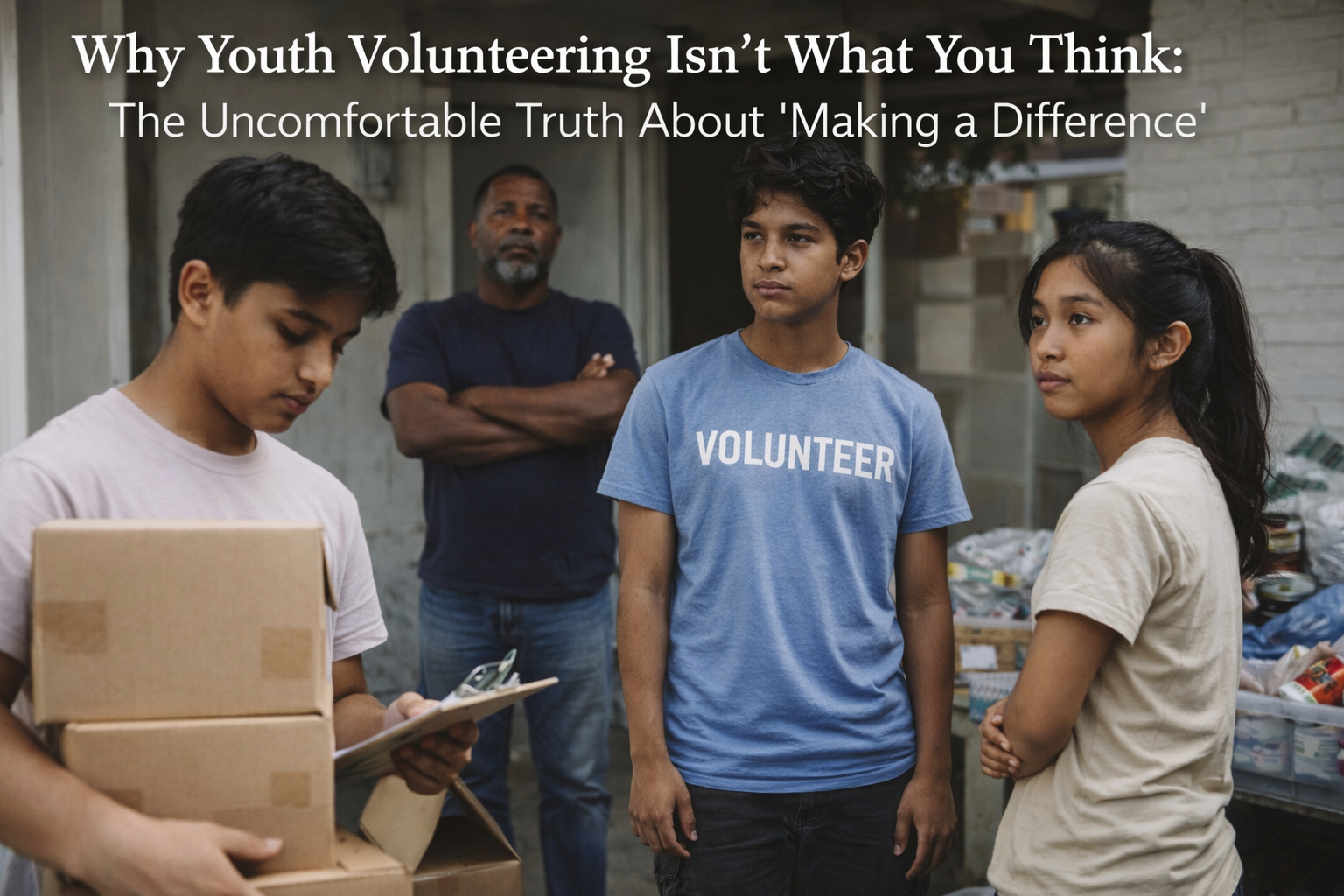
By October 3rd, most of that energy has vanished.
I’ve spent seven years working with youth volunteers through Arohan Foundation in Prayagraj, and I’ve learned something crucial: the difference between volunteering that changes lives and volunteering that just feels good is enormous. Most people never figure out which one they’re doing.
This isn’t meant to be cynical. It’s meant to be honest. Because understanding what actually creates impact—versus what merely creates Instagram content—determines whether your volunteer efforts matter.
The Voluntourism Problem Nobody Admits
Walk through any slum or village in India where NGOs operate, and you’ll encounter a strange phenomenon: children who’ve met dozens of volunteers but whose lives haven’t fundamentally improved.
These kids have been taught English by countless college students. They’ve received clothes, books, and toys from numerous charity drives. They’ve been photographed by hundreds of well-meaning young people who wanted to “document their impact.”
Yet many remain trapped in cycles of poverty, lack access to quality education, and face the same systemic barriers their parents faced.
What went wrong?
The volunteers weren’t bad people. They genuinely wanted to help. But they approached volunteering as an event rather than a commitment. They came for a day, a week, maybe a month. They provided surface-level help without addressing underlying problems. Then they left, often never to return.
This creates what I call “charity churn”—communities experiencing constant streams of temporary helpers who provide inconsistent support that doesn’t accumulate into meaningful change.
The children learn not to trust that volunteers will stay. The community learns to smile for photos while expecting nothing substantial. The volunteers return to their lives feeling accomplished without having actually accomplished much.
This isn’t helping. It’s performing help.
What Actually Creates Change
Real impact looks nothing like the volunteer experiences people post about online.
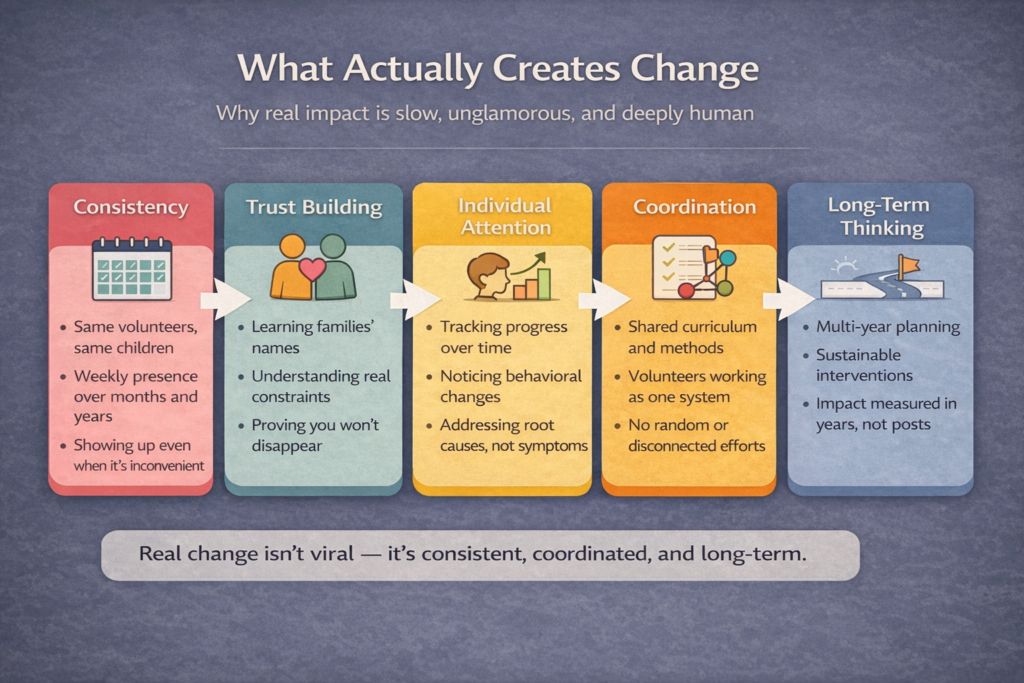
It’s showing up every single Sunday for a year to teach the same group of children, even when attendance is poor because it’s someone’s wedding or the harvest season is demanding family labor.
It’s learning the parents’ names, understanding their concerns about education, and slowly building trust that you’re not another temporary do-gooder who’ll disappear after getting your volunteer certificate.
It’s tracking individual children’s progress month-by-month, noticing when Rahul suddenly can’t focus because his family’s facing a crisis, and connecting them with resources that address root problems rather than symptoms.
It’s coordinating with other volunteers to ensure consistency, creating a curriculum that builds systematically rather than jumping randomly between topics, and maintaining relationships that last years rather than weeks.
None of this is Instagram-worthy. It’s repetitive, often frustrating work where progress happens so gradually you barely notice it.
But this is what changes lives.
At Arohan Foundation, we’ve learned that meaningful volunteer work requires three commitments most organizations never demand: consistency, coordination, and long-term thinking.
Consistency means the same volunteers working with the same children regularly. Not rotating volunteers who bring different teaching styles and create confusion. Not volunteering when it’s convenient then disappearing for months.
Coordination means volunteers working as an organized team with shared goals, methods, and tracking systems. Not individuals doing whatever feels right to them without regard for how their efforts fit into a larger strategy.
Long-term thinking means planning interventions that build over years, not events that feel good in the moment. It means measuring success by life outcomes, not volunteer attendance numbers.
These requirements eliminate most potential volunteers. People want flexibility to volunteer when it suits them. They want autonomy to help however they think best. They want immediate visible results that validate their efforts.
Real impact work doesn’t provide any of that.
The Education Paradox
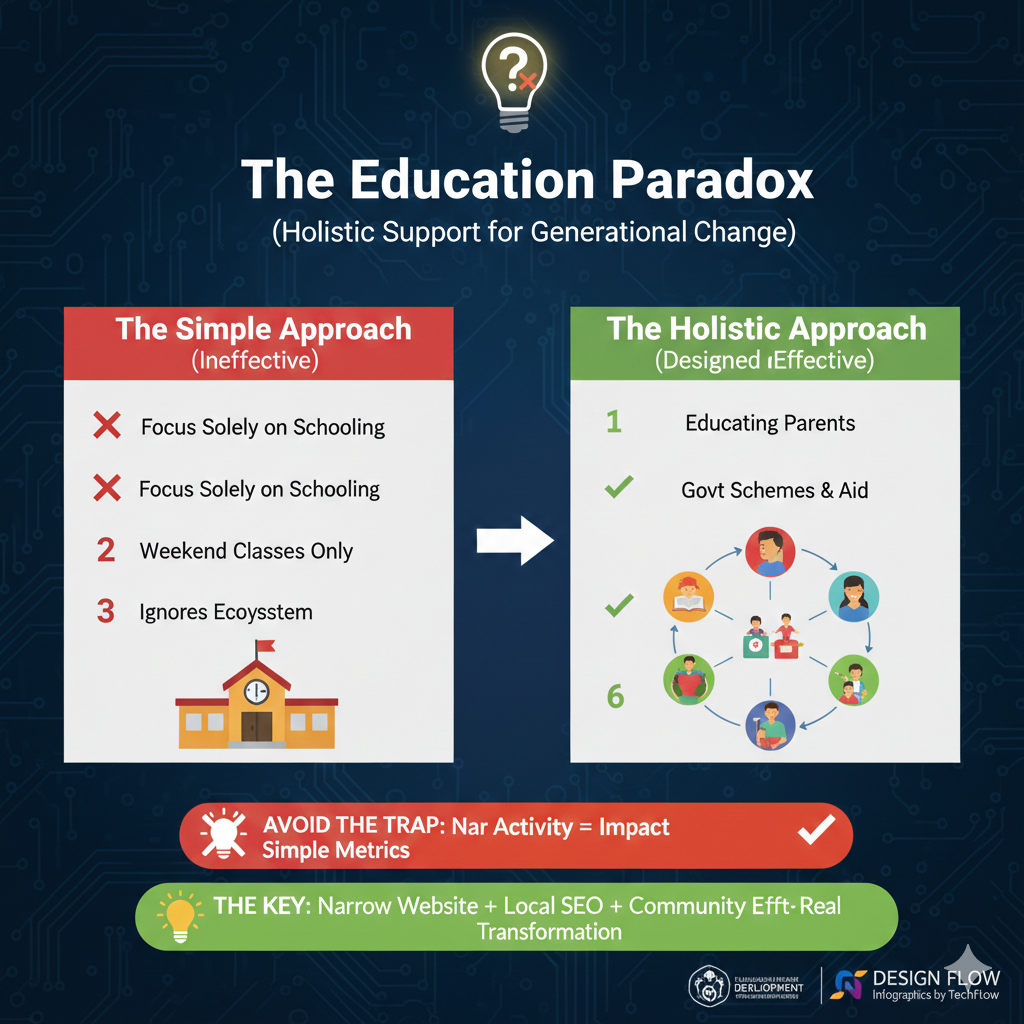
Here’s something we discovered after working with over 100 families: education alone doesn’t break poverty cycles—but it’s still essential.
This sounds contradictory, but it reflects a complex reality.
Sending a child from a slum to school doesn’t automatically change their life trajectory. They’re still returning to environments where education isn’t valued, where immediate economic needs often override long-term educational investment, and where systemic discrimination limits opportunities regardless of education level.
Simply teaching children math or English in weekend classes—what many volunteer programs do—addresses the smallest part of the problem.
What actually works: comprehensive support that addresses education while simultaneously tackling the ecosystem of challenges preventing educational success.
This includes:
- Educating parents about why schooling matters and how to support their children’s learning
- Connecting families with government schemes they’re eligible for but don’t know about
- Providing mentorship that helps children envision futures beyond what they see in their immediate environment
- Creating support systems that sustain motivation when obstacles arise
- Building life skills and 21st-century competencies alongside academic learning
- Addressing basic needs (nutrition, healthcare, safe living conditions) that impact learning capacity
Notice how much bigger this is than “teaching children.” Education is embedded within a web of interconnected challenges that must be addressed holistically.
Most volunteer organizations focus narrowly on classroom-style instruction because it’s simple to implement and produces clear metrics (number of children taught, hours of instruction provided). But these metrics often measure activity rather than impact.
Real educational transformation requires working with entire families and communities, not just individual children. It requires connecting educational interventions with broader development initiatives. It’s complex, messy work that doesn’t fit neatly into volunteer shift schedules.
The Skills Gap Nobody Talks About
Most youth volunteers arrive with enormous enthusiasm and minimal relevant skills.
They want to teach but have never studied pedagogy. They want to mentor but lack life experience to draw from. They want to solve community problems but don’t understand the communities they’re entering.
This creates a painful irony: the people most eager to help are often least equipped to help effectively.
I’m not suggesting volunteers need professional credentials before contributing. What I am suggesting: organizations need robust training systems and experienced leadership, while volunteers need humility about their limitations.
The best volunteer programs involve tiered responsibility. New volunteers work alongside experienced ones, learning effective methods before leading independently. They receive ongoing training in child development, teaching techniques, community engagement, and cultural sensitivity. They’re supervised and receive feedback about their effectiveness.
This infrastructure requires significant organizational investment. It’s far easier to just accept any willing volunteer and let them do whatever seems helpful. But that approach produces inconsistent results and sometimes causes harm.
Children from marginalized communities need reliable, skilled support—not well-intentioned experimentation.
The Measurement Problem
How do you know if your volunteer work is actually helping?
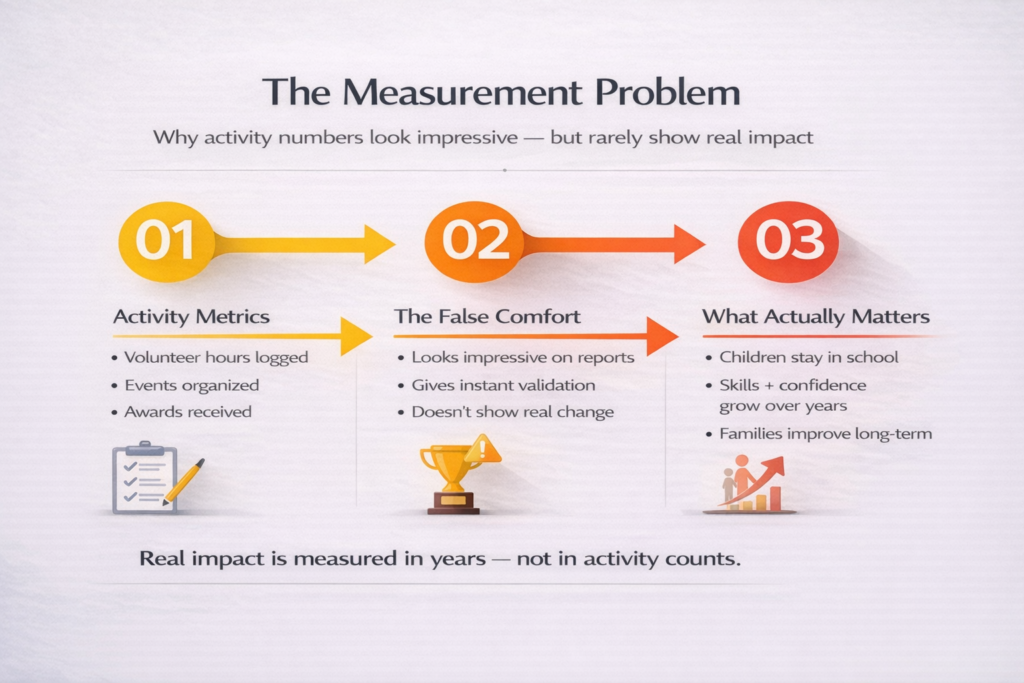
Most organizations use activity metrics: number of children enrolled, volunteer hours contributed, events organized, awards received. These numbers look impressive but reveal little about actual impact.
Arohan Foundation has received over 25 awards and organized 200+ events. The children we work with have won 150+ awards. These are sources of pride, but they don’t automatically equal meaningful impact.
What matters more: tracking individual children’s life trajectories over the years. Are they staying in school? Are their families’ economic conditions improving? Are they developing skills and confidence that will serve them long-term? Are they becoming the kind of engaged citizens who’ll contribute to their communities’ development?
These outcomes take years to measure. They’re influenced by numerous factors beyond your organization’s control. They don’t provide the immediate validation that activity metrics offer.
But they’re the only measurements that matter.
This creates a challenging tension. Funders, volunteers, and the public want to see immediate proof of impact. Organizations need to show results to maintain support. But real impact unfolds slowly and often invisibly.
The solution isn’t abandoning measurement—it’s developing sophisticated systems that track both immediate activities and long-term outcomes. This requires investment in data collection and analysis systems.
Many NGOs, especially youth-led organizations, lack systematic approaches to tracking impact. They operate based on anecdotal success stories and sincere belief in their work’s value without rigorous evidence..
The Digital Security Issue Nobody Considers
Here’s something that never appears in volunteer training but should: handling children’s and families’ information responsibly.
Volunteer organizations collect sensitive information—children’s names, family circumstances, photos, addresses, academic records, health information. In the age of social media and digital documentation, this data gets shared widely, often without proper consent or security.
Volunteers post photos of children on personal social media without considering privacy implications. Organizations store family information in unsecured spreadsheets accessible to dozens of volunteers. Names and details get shared in WhatsApp groups with minimal security.
This isn’t malicious—it’s thoughtless. But it creates real vulnerabilities.
Families from marginalized communities often can’t advocate for their own privacy. They may not understand how digital information spreads. They trust volunteers with their personal details because they see no alternative.
Organizations have ethical obligations to protect this trust. This means:
- Obtaining informed consent before photographing or sharing information about children and families
- Storing sensitive data securely with access restricted to authorized personnel only
- Creating strong security protocols for digital systems
- Training volunteers about privacy and data protection
- Never using children’s stories or images in ways that could identify or exploit them
The basics include using Well-protected passwords for all organizational systems. This seems obvious but is frequently neglected. Many NGOs use simple, shared passwords that dozens of people know, creating serious security vulnerabilities.
Protecting the people you serve requires more than good intentions. It requires systematic security practices that honor the trust communities place in you.
The Volunteer Retention Reality
Most youth volunteers quit within six months.
They arrive with idealism and energy. They imagine transforming lives and being celebrated as heroes. Reality disappoints them.
The work is repetitive. Progress is slow. Children sometimes don’t show up. Parents are skeptical or uncooperative. Other volunteers are unreliable. The impact they imagined creating doesn’t materialize quickly.
So they leave, often blaming the organization, the community, or “the system” rather than recognizing their own unrealistic expectations.
This churn devastates consistency. Children lose mentors they were beginning to trust. Programs lose institutional knowledge. Organizations waste energy constantly recruiting and training new volunteers.
The solution isn’t inspiring volunteers to greater commitment through motivational speeches. The solution is honest preparation about what volunteer work actually entails.
Arohan Foundation now explicitly tells potential volunteers: this will be harder and less immediately rewarding than you expect. You’ll spend months building relationships before seeing results. You’ll experience frustration and doubt. The children won’t always be grateful or cooperative. Your individual contribution will feel small.
If you’re looking for quick fulfillment or visible impact, this isn’t for you.
This honesty filters out people seeking resume-building experiences or emotional validation. It attracts people genuinely committed to long-term community development work.
The volunteers who stay aren’t necessarily smarter or more talented than those who leave. They’re more realistic about what the work involves and more patient about seeing results.
The Organization Reality Check
Building an effective youth volunteer organization is exponentially harder than recruiting enthusiastic volunteers.
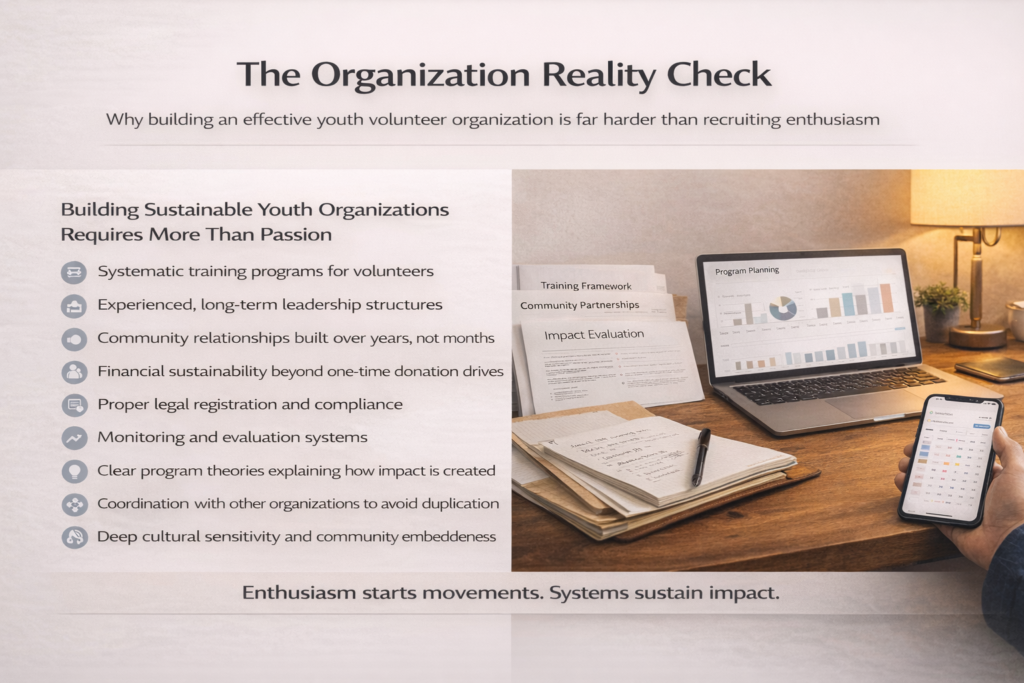
It requires:
- Systematic training programs
- Experienced leadership
- Community relationships built over years
- Financial sustainability beyond donation drives
- Proper legal registration and compliance
- Monitoring and evaluation systems
- Clear program theories about how interventions create change
- Coordination with other organizations to avoid duplication
- Cultural sensitivity and community embeddedness
Most youth-led organizations struggle with these organizational fundamentals. They’re strong on enthusiasm, weak on infrastructure.
Arohan Foundation’s registration under the Society Act 1860 provides legal foundation, but effective operations require far more than legal status. They require professionalization of volunteer management, program implementation, and organizational governance.
This isn’t exciting work. It’s administrative systems, documentation protocols, financial management, legal compliance. It’s the boring infrastructure that enables impactful programs.
Without it, even the most passionate volunteers create limited impact.
The Bridge We’re Actually Building
Arohan Foundation describes itself as bridging the gap between educated youth and underprivileged communities. That language is accurate but incomplete.
We’re not just connecting different populations. We’re attempting to build more equitable society by:
- Developing conscious citizens who understand inequality and engage with addressing it
- Creating pathways for children from marginalized communities to access opportunities typically reserved for privileged populations
- Fostering empathy and solidarity across social divides
- Building models of community development that others can learn from and replicate
This is more ambitious than simply teaching children or organizing charity drives. It’s trying to change social structures that perpetuate inequality across generations.
Success requires patience measured in decades, not months. It requires systemic thinking, not just individual interventions. It requires political consciousness about why inequality exists and how to challenge it, not just charity that treats symptoms.
Most youth volunteers aren’t ready for this level of work. They want to help individual children, not engage with complex social change. That’s fine—individual help matters. But organizations need to be honest about whether they’re doing charity work or social transformation.
The Honest Invitation
If you’re considering youth volunteering, here’s what I wish someone had told me before I started:
This work will challenge you more than you expect. You’ll question whether your efforts matter. You’ll see how systemic problems overwhelm individual interventions. You’ll experience frustration when progress is slow or invisible.
But if you commit—really commit, not just show up occasionally when convenient—you can contribute to changes that matter. Not single-handedly transforming lives, but being part of collective efforts that gradually shift possibilities for children who desperately need more opportunities.
You won’t save anyone. But you might help them save themselves.
You won’t solve poverty. But you might help individuals navigate it more successfully.
You won’t fix broken systems. But you might help people survive them while working toward longer-term change.
That’s less dramatic than the volunteer experience people imagine. But it’s more honest, more sustainable, and more respectful of the communities you’re trying to serve.
The question isn’t whether you have skills or experience. It’s whether you have patience, humility, and commitment to keep showing up even when impact isn’t visible.
Everything else can be learned. But those qualities determine whether your volunteering creates change or just creates content for your social media feed.
Choose wisely.
Conclusion
Every year on Gandhi Jayanti, we talk about seva. We quote “be the change,” share a few photos, maybe spend a day at an NGO, and go home feeling lighter — like we’ve done our part.
But real service doesn’t feel light.
It feels slow.
Sometimes boring.
Often invisible.
And strangely, that’s how you know it’s real.
After years of working with youth volunteers, I’ve realized something uncomfortable but important: the kind of volunteering that actually changes lives rarely gives you instant emotional rewards. There are no dramatic before-and-after moments. No grateful speeches. No perfect photo opportunities.
Instead, it looks like showing up on a random Sunday when nobody else does.
It looks like teaching the same math concept five different ways because one child still doesn’t understand.
It looks like sitting with a parent for an hour just to build trust.
It looks like doing paperwork, tracking progress, protecting data, coordinating schedules — the unglamorous backbone that makes real impact possible.
It looks less like heroism and more like responsibility.
And that’s the shift most people never make.
Volunteering isn’t about feeling helpful.
It’s about being useful.
Feeling helpful is easy. Anyone can donate a day, take a photo, and walk away.
Being useful requires consistency, humility, and patience — the willingness to stay long after the excitement fades.
The communities we serve don’t need visitors. They don’t need temporary saviors. They don’t need charity that disappears after a festival or holiday.
They need people who stay.
People who listen.
People who commit.
Because change doesn’t happen in a day or a camp or a drive. It happens in small, repeated acts that stack up over years — the quiet compounding of trust and effort.
So if you’re thinking about volunteering, don’t ask yourself, “How can I make an impact this weekend?”
Ask yourself, “Can I still be here next year?”
If the answer is yes — if you’re ready to show up even when no one is clapping, even when progress is invisible, even when it feels ordinary — then you’re exactly the kind of volunteer who actually changes lives.